


Main
AirAir Assemblies
AirAir Tank
LiquidAir Main
LiquidAir Core Inventory
LiquidAir Assemblies
LiquidAir Tank
Product Samples
News and Updates
Technical Support
Technology and FAQs
How to Order
About Bell Intercoolers
Contact Information


S40 Bullets
 

Designed and engineered specifically for the Volvo S40 T5, the Bell Intercoolers front mount intercooler system offers unsurpassed performance and craftsmanship. The same race winning combination found in our custom intercoolers, now available in a bolt-on system. Engineered to improve the power and efficiency of the S40 T5 forced induction system, the Bell Intercoolers system uses a larger Bar and Plate type core properly sized to safely deliver reduced intake temperatures and maximize power output on applications rated up to 325 hp.

This increased performance and efficiency translates directly into faster boost response and a denser intake air charge for more horsepower at factory boost levels and even greater power at higher boost levels. At 15 psi of boost pressure, the Bell Intercoolers system delivered a 23 hp increase over the factory intercooler system (see Technical below).

Quite simply, this system is designed and engineered to be the best upgrade intercooler for your Volvo S40 T5. Every detail reflects our motorsports experience and expert approach to intercooler system design. System includes all components required for installation.


  When Bell Intercoolers set out to design the Volvo S40 T5 Front Mount Intercooler System the goal was straightforward, improve performance and performance capacity over the factory intercooler system. To do this we focused on increasing thermal efficiency, decreasing pressure drop and improving thermal inertia, the standard performance benchmarks for an intercooler. We also focused on providing considerably more structural integrity at high boosts levels as the factory system utilizes plastic intercooler tanks and tubes, which are prone to cracking and failure under prolonged exposure to higher boost pressures and the accompanying heat increases.

Before examining the technical details, let take a quick look at the performance figures. The following data was gathered during testing sessions* utilizing a 2007 S40 T5 AWD with the following modifications: 15 psi Boost Pressure, ECU Upgrade, Low Restriction Exhaust.

Please Note: Dyno tests for the factory intercooler system and Bell Intercoolers system were performed using the SAME vehicle with no changes in engine modifications. The performance upgrades used on the test vehicle were present and identical for both the factory system and Bell Intercoolers dyno tests.


Pressure Drop
(Measured pre-intercooler inlet and post-intercooler outlet, averaged across six test runs)
Factory System: 1.87 psi pressure drop
Bell Intercoolers System: .93 psi pressure drop
Improvement: .94 psi, a 49.7% reduction in intake air flow restriction


Thermal Efficiency and Thermal Inertia (Intercooler Outlet Temperatures)
(Measured post-intercooler outlet, averaged across three test runs)
Factory System: 177º F @ 74.7º F Ambient
Bell Intercoolers System: 117º F @ 73.1º F Ambient
Improvement: 15.2º F drop in intake temperature


Horsepower Gain
18hp increase over factory intercooler system (measured at wheels). Good pressure drop and thermal efficiency numbers provide excellent details on where improvements were made, but the horsepower number is the one that easiest to translate to real world performance. This improvement in horsepower is the direct result of the increased thermal efficiency and lower pressure drop of the Bell Intercoolers system.

These numbers quantify the improvements found at the testing pressures of 15 psi boost, a pressure selected because it is representative of the average boost pressure range for most modified S40 T5s. The Bell Intercoolers system safely and efficiently handles the mass air flow of 15 psi with little effort. This is because our intercooler system is designed to remain efficient up to the 325 hp level. The Bell Intercoolers system was designed to provide maximum performance benefits to all modification levels, from stock to track-only racer. This power capacity means the Bell Intercoolers system expands with your forced induction modifications. So, whether your plans involve increasing boost pressure or installing a larger turbocharger, the Bell Intercoolers system will meet your intercooling needs.

So how did we improve on the factory system? The Volvo engineers designed the factory intercooler to work well at the factory boost level (7 psi) and at ambient air temperatures of approximately 75-80 Fº and cooler. The factory intercooler does a good job if you remain within those constraints. However, if you are planning on raising the boost pressure or if you do most of your driving in places where you see ambient temperatures over 75-80 Fº then you are going to see the efficiencies of the intercooler system dropping off, reducing performance and increasing the risk of detonation.

The Bell Intercoolers S40 T5 Front Mount Intercooler System is designed to replace the factory intercooler with a high performance, high efficiency intercooler system. A system capable of providing substantial decreases in intake air temperatures and pressure drop, even at high ambient temperatures and higher than stock boost pressures.

Intercooler Core
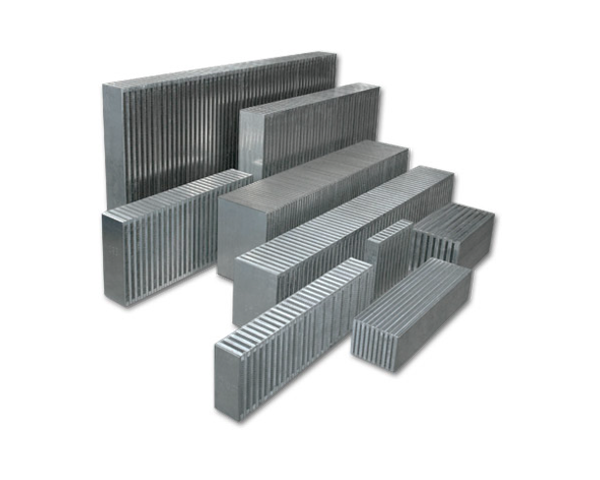
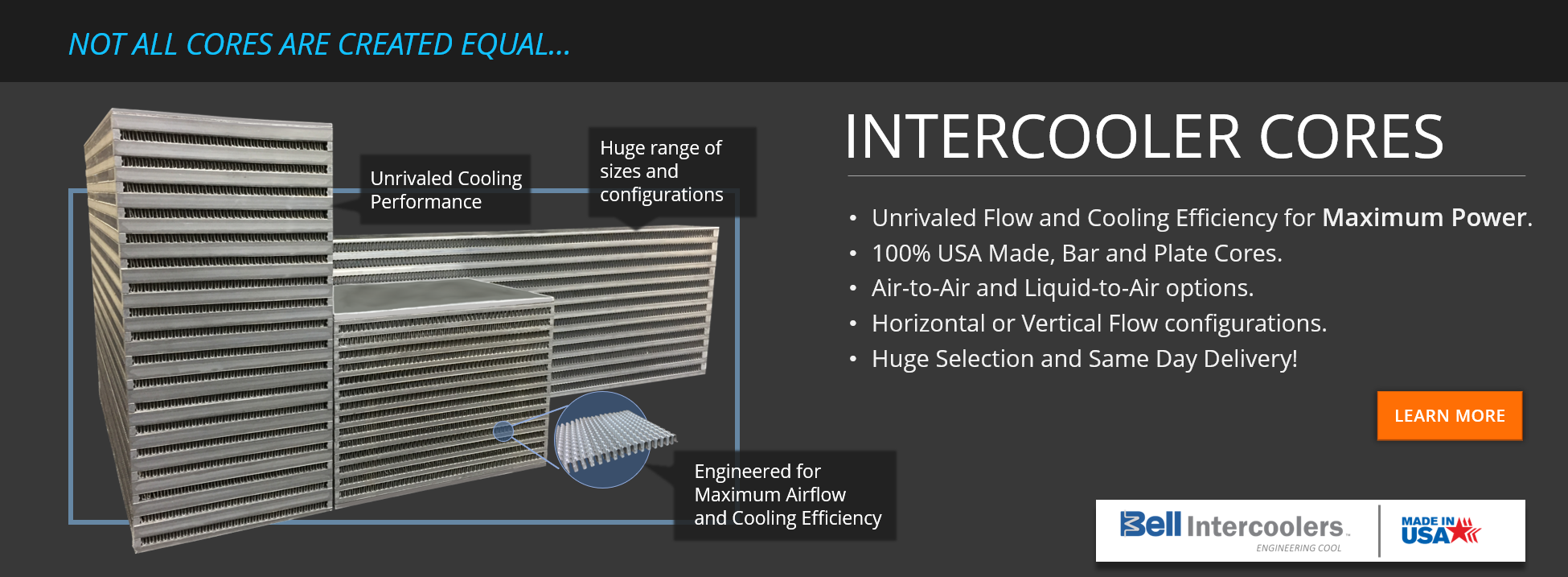
To improve on the factory design we started where we would with any of our racing intercoolers, at the core. The factory intercooler system utilizes a Tube and Fin core design and while this type of intercooler provides a cost efficient intercooler, good from a manufacturing standpoint, it does not provide the best performance. The Bell Intercoolers system uses a Bar and Plate type core designed for higher flow rates, less flow restriction (lower pressure drop), higher thermal efficiency and higher thermal inertia. The cores we use in the S40 T5 Front Mount Intercooler system are the same US made, high performance Bar and Plate cores we use in our custom racing intercoolers.

As mentioned before, the factory intercooler system is a good design, as long if you do not intend to raise boost pressure beyond the stock setting or you do not drive where the ambient temperatures are above 75-80 Fº. The Bell Intercoolers system picks up where the factory left off. By using a large  4.5” x 5.8” x  24” (thickness x height x width) Bar and Plate core, sized specifically for the Volvo S40 T5, we simultaneously increase thermal efficiency and reduce pressure drop. For comparison, the factory intercooler utilizes a 2.0” x 4.5” x 25.5” (thickness x height x width) Tube and Fin type core. The much larger Bell Intercoolers core size provides 2.9 times the internal flow area of the factory intercooler and is designed to safely, efficiently handle up to 325 hp while delivering low restriction flow and high thermal efficiency.

Why is this reduced pressure drop important? If you are producing 15 psi boost at the turbocharger and your intercooler has a 1.87 psi pressure drop, then you will only see 13.13 psi of boost pressure after the intake air has passed through the intercooler. Of course you can turn up the boost pressure at the turbo to 16.87 psi and be back to 15 psi at the intake manifold, but in doing so you have compressed the air to a higher pressure and that introduces more heat. This is additional heat that your intercooler then has to remove. This increased resistance also increases the work load of the turbocharger, increasing spool up response time. So, a low pressure drop provides higher boost pressures to the intake manifold with lower levels of adiabatic heating. A lower pressure drop also provides less resistance for the turbocharger and allows for faster spool up of the turbo for reduced turbo lag.

This larger core means more than just improved turbo response and a high power capacity, it means dramatically improved thermal efficiencies at higher ambient temperatures. While the factory system is only efficient at ambient temperatures of 75-80 Fº or below, the Bell Intercoolers system can provide high thermal efficiency up to ambient temperatures above 100 Fº. This improved thermal efficiency translates directly into increased power. One way to convey the effectiveness of an upgraded intercooler is to think of the performance difference of a turbocharged engine at 100 Fº (ambient) versus 40 Fº (ambient), a 60 Fº temperature difference. Your S40 T5 will have noticeably stronger acceleration at the cooler temperature of 40 Fº as opposed to 100 Fº. This 60 degree temperature difference is exactly what we found during our comparison testing between the factory system and the Bell Intercoolers system (at 74 Fº ambient).

Intercooler Assembly
While the intercooler core is the primary component of the intercooler assembly there are other important pieces to consider, starting with the intercooler tanks. The factory intercooler system uses a cost effective plastic tank design. These plastic tanks, while acceptable for the lower performance design specs of the stock S40 T5, are not a reliable material for increased boost pressures. This is a cost-saving measure by the factory and if you never plan to increase boost pressures then you should have nothing to worry about. Our Bell Intercoolers system features high strength aluminum intercooler tanks and inlet/outlet fittings. These are designed to withstand temperatures and pressures up to 50psi boost pressure.

We also offer a low-visibility anodized black coating (Type II Color, MIL-A-8625E) for the intercooler assembly. This standard coating provides a corrosion protection for the aluminum intercooler while offering a choice of color options.

Every component of the Bell Intercoolers system is designed for optimal performance up to 325 hp. For a final comparison, how would the factory intercooler handle 325 hp? Simply put, we wouldn’t recommend it. At the pressures and temperatures seen at that power level, it is likely that the factory intercooler system would have suffered a structural failure in the form of cracking or rupturing of the plastic intercooler tanks and intercooler tubes. If it did remain intact the intake temperatures would be too high and the pressure restrictions too great to allow the engine to function properly. Keep in mind that the factory system is designed to work well within the scope of the factory engine settings. The engineers were not designing for higher boost levels. We suspect that the factory engineers, if given an open budget and higher boost targets would have designed something similar to our system.

Test Notes
Vehicle: 2007 S40 T5 AWD

Protocol: Vehicle was tested first with the factory intercooler system, then tested again with the Bell Intercoolers system. No other modifications or alterations were made to the vehicle between tests.

Dyno: Dyno Dynamics AWD dyno, Henderson Performance Technologies, New Braunfels, Texas

Test Conditions:
Factory Test
Dec. 1, 2007
Temp: 74.7 °F
Humidity: 65-67%
Pressure: 29.92 in.

Bell Intercoolers Test
Dec. 1, 2007
Temp: 73.1 °F
Humidity: 65-67%
Pressure: 30.00 in.


  Main / Air Air Systems / Liquid Air Systems / Intercooler Kits / Accessories / Technical Support / News / Photos / Tech FAQ / About / Contact / Warranty and Returns / Privacy Policy / Terms of Use / Site Map

Copyright © 2010 Bell Intercoolers, Inc. All rights reserved. 


s